Leaders from food distribution, agriculture, government, regional planning, and nonprofit management held their first meeting on January 29, marking AfriThrive’s shift from scrappy startup to building for the long haul.
When AfriThrive was founded in 2019, the work was personal and immediate. Get fresh, culturally meaningful food into the hands of immigrant families in Montgomery County who had been overlooked by traditional food programs. Six years later, that grassroots effort has become something its founders could only have dreamed about: 13,135 families served in 2025 alone, operations spanning three Maryland counties, and a trajectory pointing toward $5 million in annual operating capacity.
Growth at that pace creates a different kind of challenge, though. The question is no longer whether AfriThrive can reach more families. It’s whether the organization has the buildings, land, equipment, and staffing to do so sustainably, without overextending its people.
That’s the reason AfriThrive has put together the Infrastructure Taskforce, an advisory group that held its first meeting on January 29, 2026. The taskforce pulls together leaders from food distribution, agriculture, government, regional planning, insurance, and nonprofit management to help AfriThrive’s leadership make the growth decisions that will shape the organization’s next decade.
A Turning Point, Not Just a Milestone
Dr. Truphena Choti, AfriThrive’s Founder and CEO, is blunt about what this moment represents. The organization is intentionally moving from opportunity-driven growth to building durable, long-term operations. The decisions made in the next 12 to 24 months about buildings, farmland, technology, and staffing will determine whether AfriThrive can sustain its impact at the level communities are demanding.
Look at the numbers. AfriThrive served approximately 49,000 individuals last year across Montgomery County, Baltimore County and City, and Prince George’s County. The organization runs a 2-acre Cultural Farm in Poolesville, greenhouse operations, mobile food distribution, school-based food assistance, nutrition and health programming, and youth leadership development through its Changemakers and Balozi programs. In Essex, a 3,100-square-foot building has been secured but remains an empty shell, needing significant funding to become usable.
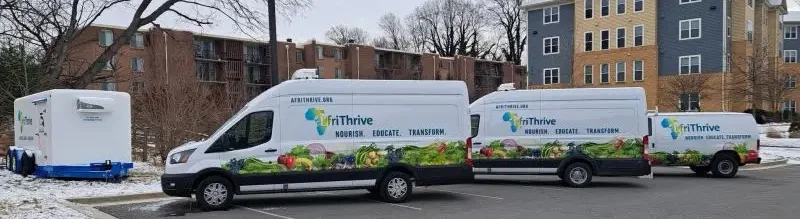
Meanwhile, 80 percent of operations run out of Montgomery County, where services are delivered from a church parking lot. The partnership enables access, but it comes with real limitations: weather exposure and limited restroom access among them. There’s no central office or warehouse. Staff work virtually across multiple sites and counties.
Put simply, the physical setup hasn’t kept pace with the mission. Continuing to grow through ingenuity alone isn’t a strategy. It’s a risk.
What the Taskforce Will Do
The Infrastructure Taskforce is an advisory group designed to help AfriThrive leadership think through some of the most consequential decisions the organization has faced. Members will serve as strategic thinking partners, helping to figure out which investments in land, buildings, and technology should come first. They’ll weigh in on the order and timing of major spending decisions, flag risks and blind spots before fundraising begins, and pressure-test plans against what the organization can realistically handle.
Their main goal: produce a prioritized growth plan, a clear document laying out which infrastructure investments matter most, in what order, and why. That plan will guide AfriThrive’s fundraising and its next phase of growth.
The questions on the table are significant. Which investments will do the most to help AfriThrive grow sustainably? Should the organization put everything under one roof or keep operating across multiple locations in different counties? How should it handle the Essex building, the need for space in Montgomery County, and expanding farmland, all at once or one at a time? And where should AfriThrive slow down to avoid growing faster than it can manage?
None of these have easy answers. They require the kind of expertise and judgment that AfriThrive’s leadership team recognized it needed from outside advisors.
Who Is at the Table
The taskforce membership reflects the range of experience AfriThrive was looking for. Jackie DeCarlo, former CEO of Manna Food Center and Chair of Nonprofit Montgomery, serves as facilitator, bringing deep experience in food access and nonprofit leadership. The full membership includes:
- Jackie DeCarlo, former CEO of Manna Food Center and Chair of Nonprofit Montgomery (Facilitator)
- Dr. Antwan Brown, Maryland Governor’s Commission on Community Initiatives
- Taylor LaFave, City of Baltimore
- Alexandra Lewin-Zwerdling, Fruitful, LLC
- Tom McDougall, 4P Foods
- Sarah Mugo, USI Insurance
- Lindsay Smith, Metropolitan Washington Council of Governments
- Dr. Truphena Choti, AfriThrive
The mix is intentional. Government representatives bring policy and planning perspective. People who actually grow, move, and distribute food understand the logistics and costs of doing it at scale. Regional planners make sure AfriThrive’s growth lines up with what’s happening across the greater Washington area. And having insurance and risk management at the table pushes the organization to think about long-term sustainability in ways nonprofits often skip.
The Bigger Picture
For AfriThrive, this taskforce isn’t really about buildings and land. It’s about building the kind of organization that communities can count on every single day, not only when urgency strikes.
The long-term vision includes a 5-plus-acre farm that would train new farmers, support workforce development, and strengthen the region’s ability to feed its own communities for years to come. Reaching that goal requires careful, well-timed investments, and that’s exactly what the taskforce is designed to guide.
“Better decisions now lead to stronger, more sustainable growth later,” Dr. Choti has said. That philosophy, intentional and community-centered, grounded in the belief that food access is about real infrastructure and not just goodwill, drives everything AfriThrive builds.
The taskforce will meet regularly throughout 2026. Updates will be shared through AfriThrive’s website and social channels.